
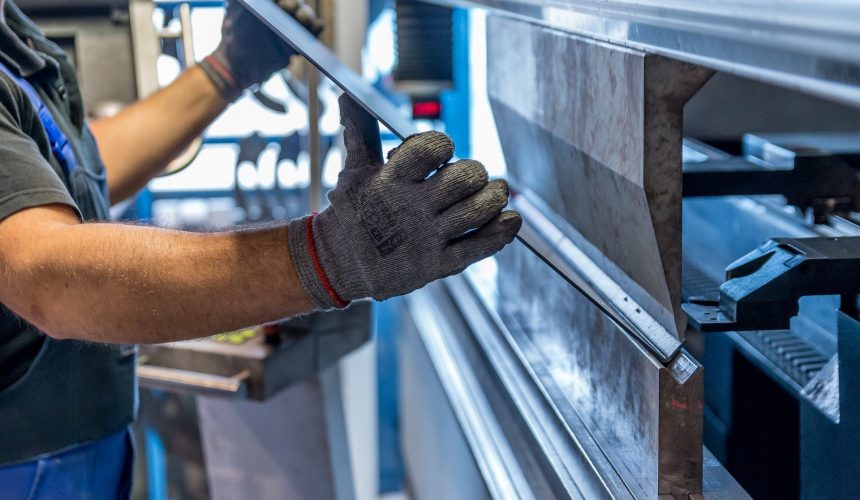
Moving machinery can cause injuries in many ways:
- People can be struck and injured by moving parts of machinery or ejected material. Parts of the body can also be drawn in or trapped between rollers, belts and pulley drives.
- Sharp edges can cause cuts and severing injuries, sharp-pointed parts can cause stabbing or puncture the skin, and rough surface parts can cause friction or abrasion.
- People can be crushed, both between parts moving together or towards a fixed part of the machine, wall or other object, and two parts moving past one another can cause shearing.
- Parts of the machine, materials and emissions (such as steam or water) can be hot or cold enough to cause burns or scalds and electricity can cause electrical shock and burns.
- Injuries can also occur due to machinery becoming unreliable and developing faults or when machines are used improperly through inexperience or lack of training.
A company was sentenced for breaching health and safety regulations after an employee was dragged into a machine on the production line.
The Crown Court heard how on 13 February 2016, while observing the operation of a production machine, the technical operator placed his right hand close to a gap in the machine housing. An emery cloth held in his right hand was dragged into the machine taking his arm with it.
The employee was unable to reach any of the emergency stop buttons located around the machine from the position in which he was trapped. He had to be released from the machine by paramedics. He suffered a double compound fracture to his arm, which required surgery.
An investigation by the Health and Safety Executive (HSE) found the company had failed to prevent access to dangerous moving parts of the machine, namely an ‘in-running nip’. There was a gap large enough to allow access at a belt conveyor entry on the line.
The company pleaded guilty to breaching Reg 11 of the Provision and Use of Work Equipment Regulations 1998. They were fined £640,000 and ordered to pay £26,234 in costs.
Speaking after the hearing, the HSE inspector said: “This is a tragic incident that could so easily have been avoided. The risks inherent in failures to properly guard dangerous parts of machinery are well known in industry and to the company.
“Companies should be aware that the HSE will not hesitate to take appropriate enforcement action against those that fall below the required standards.”
Preventing access to dangerous parts
Think about how you can make a machine safe. The measures you use to prevent access to dangerous parts should be in the following order. In some cases, it may be necessary to use a combination of these measures:
- Use fixed guards (e.g. secured with screws or nuts and bolts) to enclose the dangerous parts, whenever practical. Use the best material for these guards – plastic may be easy to see through but may easily be damaged. Where you use wire mesh or similar materials, make sure the holes are not large enough to allow access to moving parts.
- If fixed guards are not practical, use other methods, e.g. interlock the guard so that the machine cannot start before the guard is closed and cannot be opened while the machine is still moving. In some cases, trip systems such as photoelectric devices, pressure-sensitive mats or automatic guards may be used if other guards are not practical.
- Where guards cannot give full protection, use jigs, holders, push sticks etc if it is practical to do so.
- Control any remaining risk by providing the operator with the necessary information, instruction, training, supervision, and appropriate safety equipment.
Information source:
https://www.hse.gov.uk/toolbox/machinery/safety.htm
https://press.hse.gov.uk/2021/01/13/company-fined-after-worker-traps-arm-in-machine